
Over the past few decades, micro stepper motors, as the core components of precision motion control, have silently supported countless applications ranging from printers to medical equipment. With their precise stepping angles, stable torque, and reliable open-loop control, they have become indispensable “muscle fibers” in fields such as industrial automation and consumer electronics. However, with the explosive evolution of artificial intelligence technology, we are standing at a new turning point: when AI endows these tiny components with “brain” and “perception”, a truly intelligent micro-motion era is about to unfold around 2030.

一、The intelligent evolution of micro stepper motors:
from execution to thinking Traditional micro stepper motors typically operate under open-loop control based on preset pulse signals. While their accuracy is sufficient, they often appear “clumsy” in complex and dynamic environments – they are unable to sense load changes, adjust parameters on their own, and predict failures. The introduction of AI is fundamentally changing this situation.
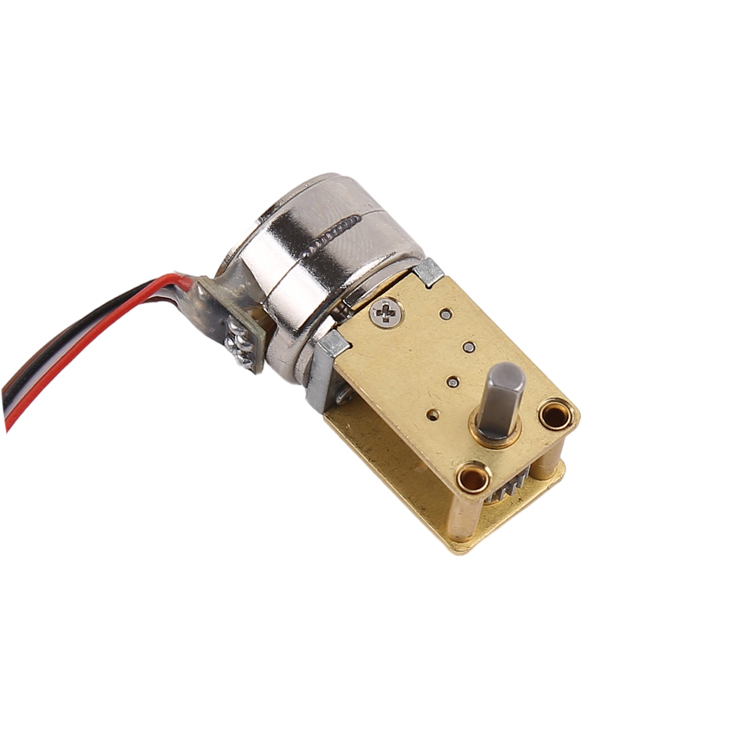
By 2030, we are expected to see smart micro stepper motors equipped with built-in edge AI chips. These motors not only integrate high-precision encoders but also analyze operational data in real-time through machine learning algorithms. For instance, the motor can autonomously learn the changes in load inertia, automatically adjust current and subdivision drive, and avoid step loss and resonance; it can also predict bearing wear through vibration and current characteristics, issuing maintenance warnings in advance. This shift from “passive execution” to “active adaptation” will make micro stepper motors become truly intelligent execution units.
二、To achieve intelligent micro-motion through key technological breakthroughs driven by AI, breakthroughs are needed in several core technological fields:
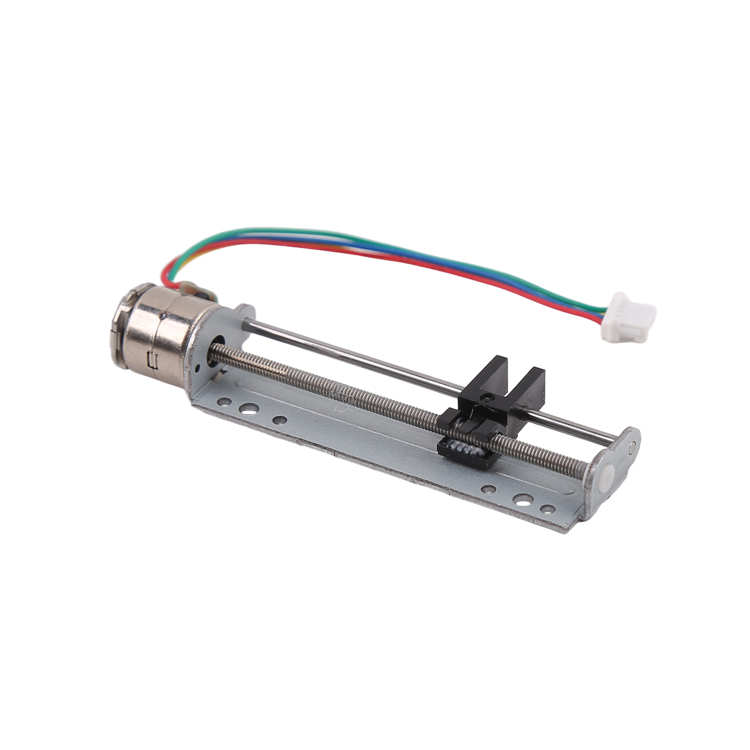
- Perception fusion and state estimation AI algorithms can fuse multi-dimensional sensor data such as encoder position, current waveform, and temperature to construct a real-time digital twin model of the motor. Through deep learning, the model can accurately estimate the current load torque, friction coefficient, and even environmental disturbances, thus providing a basis for control decisions.
- Traditional PID parameter tuning for adaptive control algorithms relies on human experience, whereas controllers based on reinforcement learning can continuously optimize parameters during operation. For instance, in a robotic arm driven by a micro stepper motor, AI can adjust the motion trajectory in real-time to complete the grasping task with minimal energy consumption while ensuring smooth movement.
- In Prognostics and Health Management (PHM), AI can identify early signs of anomalies in motor operation through long-term time series analysis (such as LSTM networks). It is predicted that by 2030, the accuracy of fault early warning for intelligent micro stepper motors will exceed 95%, significantly reducing the risk of equipment downtime.
二、Application Scenarios: The widespread adoption of intelligent micro stepper motors, ranging from humanoid robots to internal medical applications, will give rise to a host of novel application scenarios:
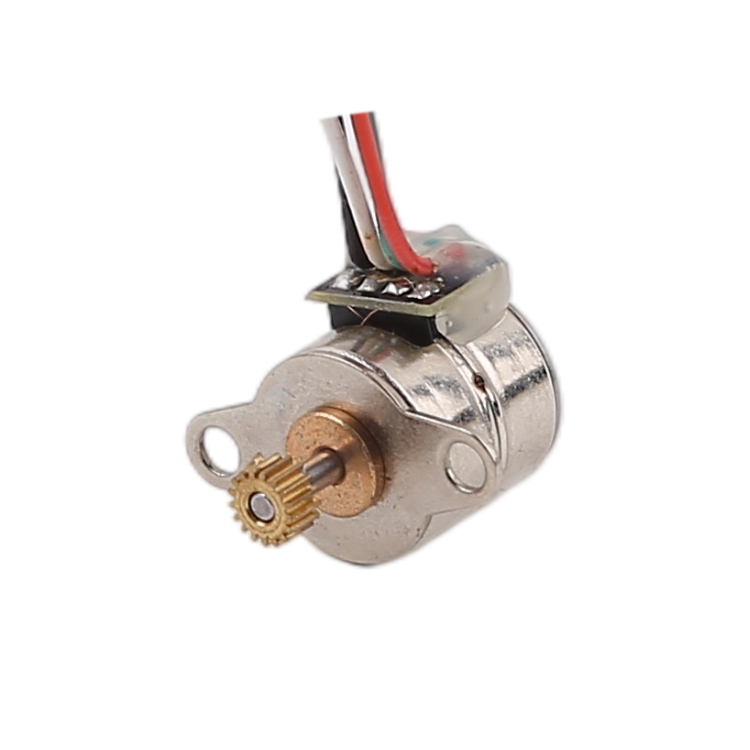
Dexterous Fingers of Humanoid Robots To enable humanoid robots to perform fine manipulations akin to human hands, a multitude of micro actuators are required. By 2030, intelligent micro stepper motors with a diameter of less than 4 millimeters will incorporate tactile sensing and force control algorithms, allowing robotic fingers not only to grasp eggs but also to perceive the material and sliding tendency of objects.
In vascular intervention surgery using minimally invasive medical robots, the catheter driven by a micro stepper motor requires millimeter-level precision in advancing and retracting. Combined with AI visual navigation, the motor can automatically adjust its advancing speed based on real-time images, avoiding damage to the vascular wall and even autonomously completing targeted drug delivery to the lesion site.
In the future, AR glasses for wearable smart devices will rely on micro stepper motors to quickly adjust the optical module and automatically zoom according to the direction of the human eye’s line of sight. AI analyzes eye movement data to predict the user’s gaze point, and the motor completes focusing in milliseconds, providing a seamless experience of merging virtual and real worlds.
In the context of Industry 4.0, thousands of micro stepper motors in a distributed smart factory will serve as nodes in the industrial Internet of Things. They share their operational status through wireless communication, and cloud-based AI coordinates the movement rhythm of the entire production line, achieving optimal energy consumption and maximized output.
四、Challenges and the Path Ahead Despite the promising prospects, the large-scale application of intelligent micro stepper motors still faces challenges:
Power consumption and heat dissipation: Integrating an AI chip will increase power consumption. For micro-motors, the key is how to address the heat dissipation issue within a limited volume.
Cost control: Currently, the cost of smart actuators is much higher than that of traditional products, and it requires a mature industrial chain to reduce costs.
Algorithm reliability: In the medical and automotive fields, where safety is paramount, AI decisions must be explainable and fully validated.
By 2030, we may witness the establishment of industry standards and the integrated design of dedicated AI chips and micro stepper motors. Some leading manufacturers have already begun prototype testing, and it is expected that smart micro stepper motors will gradually penetrate the high-end equipment sector within the next five years.
五、Conclusion:
The era of intelligent micro-motion has arrived. When AI meets micro stepper motors, we are not only welcoming a technological upgrade, but also an innovation in the concept of motion control. From mere “rotation” to a closed loop of “thinking-sensing-executing”, micro stepper motors will become the basic unit of the intelligent world. 2030 may just be the starting point, but it is enough to convince us that the true era of intelligent micro-motion is accelerating towards us.
Post time: Mar-06-2026